
8 Key Benefits of Virtual Firewalls for Cloud and Hybrid Environments

How software-defined firewalls deliver enterprise-grade protection without the hardware constraints
The rapid adoption of cloud and virtualized infrastructures has fundamentally changed how organizations must approach network security. Traditional perimeter-based hardware firewalls, while still relevant at the edge, cannot deliver the flexibility, granular visibility, and operational agility that modern cloud-native and hybrid environments demand.
Virtual firewalls, also called software-defined firewalls or cloud firewalls, are purpose-built to address this gap. Unlike physical appliances, virtual firewalls run as software instances within hypervisors, private clouds, or public cloud platforms such as AWS and Microsoft Azure. They enforce the same enterprise-grade security policies as their hardware counterparts, but without the constraints of fixed-form hardware.
The following sections examine the eight core benefits of virtual firewalls and explain why they have become a foundational component of modern security architecture.
Virtual Firewall Benefits at a Glance
Here is a quick look at the benefits of virtual firewalls.
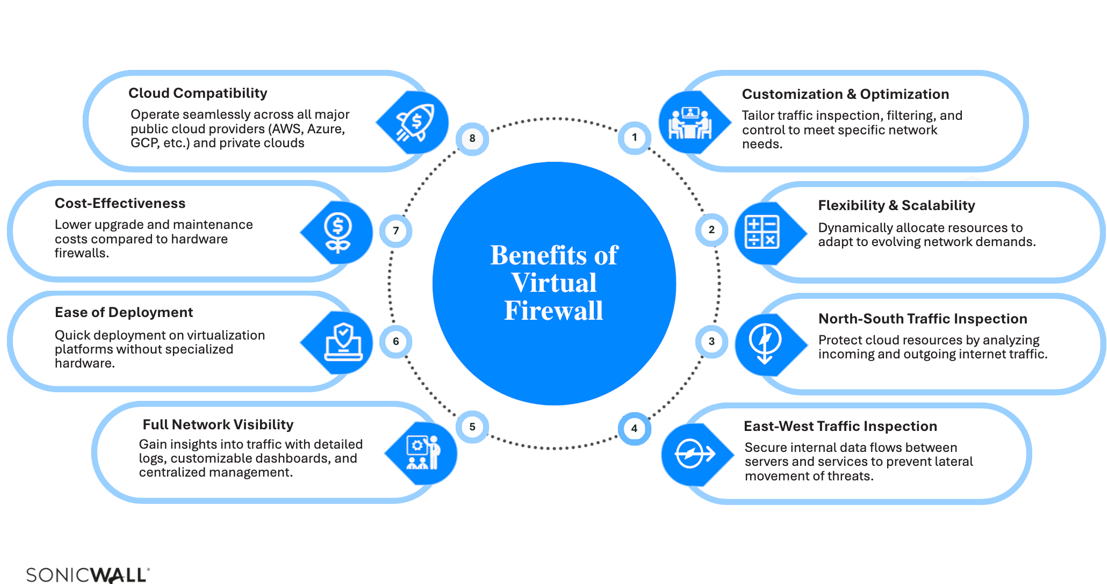
1. Customization and Optimization
One of the most significant advantages of a virtual firewall is its ability to be tailored to specific network requirements. Organizations can customize traffic inspection, filtering rules, and access control policies based on their operational needs rather than being constrained by hardware capabilities or vendor-defined feature sets.
This level of customization enables:
- Granular traffic control based on application, user, and device
- Application-specific filtering with deep packet inspection
- Policy enforcement based on user roles or departments
- Optimized resource allocation for performance efficiency
By adapting security controls to match the network architecture, virtual firewalls ensure precise protection without unnecessary processing overhead. This is particularly valuable in multi-tenant environments where different business units require distinct security postures.
2. Flexibility and Scalability
Modern infrastructure is dynamic. Workloads scale up and down based on demand, new services are deployed continuously, and security must keep pace with all of it.
Virtual firewalls allow organizations to dynamically allocate computing resources to handle changing traffic volumes. Unlike physical appliances, scaling does not require purchasing, provisioning, or installing new hardware. Administrators can spin up additional instances in minutes.
This flexibility enables:
- Rapid response to traffic spikes during peak demand
- Seamless scaling during business growth or mergers
- Elastic security for cloud-native and containerized environments
- Simplified management of evolving network demands across geographic regions
As infrastructure grows, the virtual firewall grows with it, efficiently and without disruption.
3. North-South Traffic Inspection
North-south traffic refers to data entering or leaving the network boundary, particularly internet-bound traffic crossing the perimeter. Comprehensive inspection of this traffic flow is a core function of any firewall, and virtual firewalls deliver it in full.
Virtual firewalls provide thorough inspection of all inbound and outbound traffic, ensuring that:
- Malicious external threats are detected and blocked at the perimeter
- Unauthorized access attempts are identified and prevented
- Internet-facing applications are protected from exploitation
- Data exfiltration risks are minimized through outbound traffic analysis
By monitoring external traffic, organizations can safeguard cloud resources from external threats before they reach critical systems or data stores.
4. East-West Traffic Inspection
In cloud and virtual environments, a significant portion of traffic flows internally, between virtual machines, microservices, containers, and backend servers. This lateral traffic, known as east-west traffic, is invisible to perimeter-only defenses and represents a major attack surface.
Virtual firewalls secure these internal data flows by:
- Enforcing micro-segmentation between workloads and service tiers
- Monitoring inter-service communication for anomalous behavior
- Preventing lateral movement during active attacks or after initial compromise
- Isolating compromised systems to contain the blast radius of an incident
East-west inspection is critical in zero-trust architectures and modern cloud deployments, where threats often spread internally once initial access is gained. Virtual firewalls provide the visibility and control required within the virtual fabric itself, at both the hypervisor and cloud layer.
5. Full Network Visibility
Effective security management requires comprehensive visibility into network activity. Virtual firewalls provide detailed logging, traffic analytics, and centralized management capabilities, giving security teams a complete operational picture.
Organizations benefit from:
- Comprehensive traffic logs with granular detail by session, application, and user
- Customizable dashboards for real-time and historical analysis
- Real-time monitoring and alerting for anomalous behavior
- Centralized policy management across hybrid and multi-cloud environments
This enhanced visibility allows security teams to identify anomalies quickly, respond to incidents efficiently, and maintain continuous awareness of network activity, a requirement for meeting compliance mandates such as PCI DSS, HIPAA, and SOC 2.
6. Ease of Deployment
Deployment simplicity is another major operational advantage. Virtual firewalls can be rapidly deployed within virtualization platforms or cloud environments without specialized hardware, data center space, or lengthy procurement cycles.
They offer:
- Faster setup and configuration compared to physical rack-and-stack deployments
- Reduced infrastructure complexity through software-only installation
- Minimal physical installation requirements, with no rack space or cabling
- Quick provisioning in new environments, including remote offices and branch locations
This streamlined deployment process makes virtual firewalls particularly attractive for organizations seeking agility, supporting rapid digital transformation initiatives and infrastructure-as-code workflows.
7. Cost-Effectiveness
Virtual firewalls eliminate the need for physical security appliances, significantly reducing capital expenditure. Organizations also benefit from lower operational costs, including maintenance, upgrades, and hardware lifecycle management.
Key cost advantages include:
- No hardware procurement, shipping, or installation costs
- Subscription-based or pay-as-you-grow licensing models
- Reduced power and cooling requirements in data centers
- Lower ongoing maintenance expenses and no hardware refresh cycles
For many organizations, this translates into a more predictable and efficient security investment with a faster return than equivalent physical deployment. Total cost of ownership studies consistently show that virtual firewalls deliver meaningful savings across both CAPEX and OPEX categories.
8. Cloud Compatibility
Virtual firewalls are designed to operate seamlessly across major public cloud providers and private cloud environments. This broad compatibility ensures that security policies are consistent regardless of where workloads reside.
Supported platforms typically include:
- Public cloud: Amazon Web Services (AWS), Microsoft Azure, Google Cloud Platform
- Private cloud and hypervisors: VMware ESXi, Microsoft Hyper-V, KVM, Proxmox
- Network function virtualization (NFV) and SD-WAN architectures
This broad compatibility ensures:
- Consistent security policies across multi-cloud deployments
- Smooth hybrid cloud integration with on-premises environments
- Simplified migration from on-premises to cloud without policy gaps
- Unified protection across diverse and heterogeneous infrastructures
Cloud compatibility makes virtual firewalls a strategic choice for organizations embracing hybrid and multi-cloud architectures, enabling a single security model across all deployment targets.
The table below summarizes all eight benefits, the capabilities each delivers, and the corresponding business impact.
| What It Delivers | Benefit | Business Impact |
| Granular traffic control and role-based policy enforcement | Customization & Optimization | Precise protection without unnecessary overhead |
| Dynamic resource allocation without hardware purchases | Flexibility & Scalability | Elastic security that grows with the business |
| Comprehensive inspection of all internet-bound traffic | North-South Traffic Inspection | Blocks external threats before they reach critical systems |
| Internal traffic monitoring between virtual workloads | East-West Traffic Inspection | Prevents lateral movement and contains breaches |
| Real-time monitoring, logging, and centralized dashboards | Full Network Visibility | Faster anomaly detection and incident response |
| Quick provisioning with minimal physical infrastructure | Ease of Deployment | Faster time-to-security with lower complexity |
| Eliminates hardware capex; subscription-based licensing | Cost-Effectiveness | Predictable, lower-cost security investment |
| Native support for AWS, Azure, VMware, Hyper-V, KVM, Proxmox | Cloud Compatibility | Consistent policy across hybrid and multi-cloud environments |
Conclusion
Virtual firewalls deliver a comprehensive range of capabilities tailored for modern, cloud-driven environments. From customization and elastic scalability to advanced east-west and north-south traffic inspection, they provide the flexibility and protection required in today's distributed networks. By enabling secure connectivity, enhancing end-to-end network visibility, and supporting seamless integration across public cloud, private cloud, and on-premises environments, virtual firewalls have become an essential component of contemporary security architecture.
Organizations evaluating virtual firewalls should consider not only the capabilities of individual features but also how the solution integrates into a broader, layered defense-in-depth strategy. A virtual firewall that operates alongside IPS, sandboxing, botnet filtering, and DNS security delivers significantly stronger protection than any single control deployed in isolation.
Learn More: Explore SonicWall Network Security Virtual (NSv) firewalls
Try It: Sign up for an NSv trial
Share This Article

An Article By
An Article By
Lokesh Kannaiyan
Lokesh Kannaiyan

Leelin Thye
Senior Manager, Product Marketing
Leelin Thye
Senior Manager, Product Marketing

